An energetic and flowing reading of Bach's famous "Little Fugue in G minor" (BWV 578). From Peter Planyavsky's all-Bach recording on the Marcussen organ of Fukushima Concert Hall (recorded 1986).
Tuesday, January 17, 2012

Countdown to Planyavsky at MIT (11 days)

Some interesting comments by Peter Planyavsky on the possibilities of writing good music for the post-Vatican-II church:
"You are not to write a 'pretty' or 'interesting' piece which 'can also be performed in the liturgy,' but rather, you should truly compose above all for liturgical use – with all the consequences. ...
"All right, let's talk about the Responsorial Psalm. Whoever has in mind an awful, primitive, monotonous little ditty should please think again. Nowhere is it demanded that it may not be elaborate, dignified, polyphonic, and original. Fundamentally the structure of solo psalmody should be maintained, but there is much more that can be done with it. The same is true for the Alleluia verse. Further: the manifold possibilities of alternation by stanza between choir and congregation are not yet exhausted. ...
"So far, none of the church music alarmists has been able to explain to me how the task of setting the 150 psalms (that is 77 pages), compared to the Ordinary (that is two pages), represents a limitation. ...
"I resist any fundamental charge of a deficit for which the liturgy of the Second Vatican Council would be guilty. The foundational and functionally coherent involvement of the congregation (and that does not mean always, everywhere, constantly, and primitively!) is not a bureaucratic spawn of a few music-hating liturgists. Rather, it was a radical innovation of our [twentieth] century that was awaited with longing all across Europe and in many places already practiced illegally by anticipation. Again, I wish to emphasize, the effects for sacred msuic have been predominantly positive and inspiring to the imagination."
(Peter Planyavsky, "Komponieren, aber für die heutige katholische Liturgie" ("Compose, But for the Current Catholic Liturgy"), Singende Kirche, 1988f. English translations from "Sacred music and liturgical reform: treasures and transformations" by Anthony Ruff (2007).)


Sunday, January 15, 2012
Countdown to Planyavsky at MIT (12 days)
 For decades, Peter Planyavsky was the organist and/or music director of the Stephansdom in Vienna, one of the world's great cathedrals. The highlight of his tenure was undoubtedly the installation of the Rieger organ in 1991. It must certainly be the most heroic 56-stop tracker ever built! Playing a concert on it in 2001, on my very first European tour, was one of the great thrills of my life (especially the Liszt B-A-C-H). The 32' Principal does not purr; it roars. And I remember the Pedal reeds 16' and 8' being so large-scale that, even in big pieces, I usually used one or the other. But then there were more delicate colors on the Brustwerk and elsewhere. In fact, I had no trouble finding the right textures for the Bach Trio Sonata that I played. (I can't think of many cathedrals in which I would attempt such a work.) On the Solowerk, the big reed with the big cornet enable a melody to soar above the rest of the organ in a very Planyavskian sound.
The Pipedreams website has featured this instrument in five of its problems. Links to all can be accessed from this page:
http://pipedreams.publicradio.org/gallery/austria/vienna_stephansdom_rieger.shtml
Photo: the author at the Stephansdom organ (July, 2001).
Saturday, January 14, 2012
Countdown to Planyavsky at MIT (13 days)
Last week in one of my posts, Marian Ruhl Metson wrote of her experience with the composition by Peter Planyavsky, "Fantasie in memoriam A.H." (The title refers, of course, to Anton Heiller). Below are YouTube links of this very interesting composition, played by a student of Planyavsky, Peter Peinstingl.
Friday, January 13, 2012
Countdown to Planyavsky at MIT (14 days)
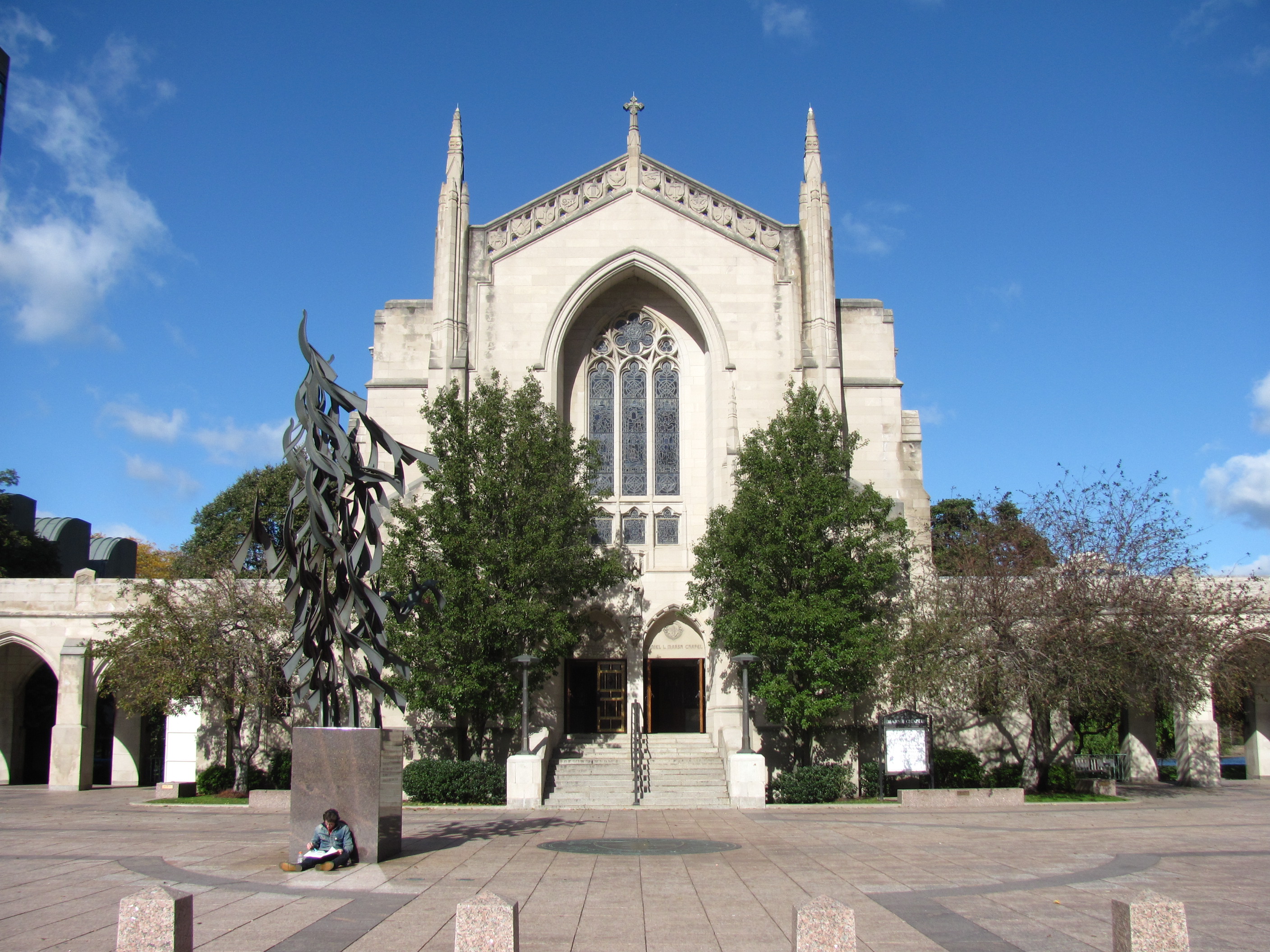 By now you've heard me mention that on Friday, January 27, at 8 p.m., legendary Viennese organist Peter Planyavsky will play an organ recital at MIT's Kresge Auditorium. But I want to mention also that earlier that day, from 10 a.m. to 12 p.m., Planyavsky will give an organ masterclass at Boston University's Marsh Chapel, featuring a student from MIT and several students from BU's Master of Sacred Music program.
The Master of Sacred Music (MSM) program is quite an extraordinary one; there is not another program like it in Greater Boston. The MSM degree is offered jointly through the School of Theology and the School of Music and administered by the School of Theology. Since the MSM is essentially professional training for employment as a church musician, the program is offered with two concentrations: organ and choral conducting. The distinguished MSM faculty include Dr. Andrew Shenton (MSM Program Director) and Peter Sykes (organ). It's a program that's as wonderful as it is unique. Kind of wish I were a student again, so that I could enroll!
Thursday, January 12, 2012
Countdown to Planyavsky at MIT (15 days)
 Photo: The 1742 Schmahl organ in Sitzberg, near Zürich.
Peter Planyavsky was one of Heiller's greatest students and closest friends. He later became Heiller's biographer. Who was this Heiller character?
Anton Heiller was the greatest interpreter of Bach's organ works of his time -- maybe of all time. But there are several facts that are very interesting about this.
First: It's hard to think of anyone else of Heiller's generation or the generation before who played Bach anything like him. From whom did he learn how to play Bach like that? Who influenced him? Where did he get it? (I asked that question once to my teacher, the Heiller student Yuko Hayashi. She answered, "From Bach.")
Second: Heiller could as easily have had a career as a conductor. In fact, at age 23 he was offered the job as conductor of the Vienna State Opera! He turned it down. Why? So that he could devote more time to playing Bach on the organ!
There isn't space to speak of Heiller's Bach playing in any detail. But there is an anecdote worth repeating, told to me in 1994 by Yuko Hayashi.
YH: He played the Orgelbüchlein up in the hills near Zürich [Sitzberg]. An organ restored by Metzler [in 1961, built by G. F. Schmahl c. 1742] And I was assisting him, turning pages. Jean-Claude Zehnder was there. By the way, I'm not a good assistant, so I stayed away from doing it. But that one time in Switzerland when I did do it, it was so EASY. He had this rhythm in his body, and he didn't have to do anything like that [nodding]. He didn't have to nod, he BREATHED. And I felt his breathing. It was so easy.
LC: Like a singer, he breathed, and you knew exactly where to turn the page or pull the stop.
YH: And he was so relaxed. Before the concert he was very nervous. But when the music started … CALM.
LC: So he played the concert.
YH: First he had dinner. Then he went up to this mountain, when into the church, and started to try out registrations, one after another, while Jean-Claude Zehnder and a few students from out in the church would say, "That's good." Then it was time for the concert. Double the amount of people that the church could hold showed up! And you know what he did? He announced to the audience, "Half of you go back into town for dinner and come back later." He played the recital, the whole Orgelbüchlein. He smoked for ten minutes -- in those days he smoked. Now the second audience that had had dinner was in place in the church, and he played the recital AGAIN! I got tired just turning the pages. He got better and better. Meanwhile, there were cows around. The cows liked the music. You could see them through the windows and hear their beautiful bells.
LC: And this was all happening during the concert?
YH: Yes.
LC: It must have been idyllic, having this mixture of nature and classical music.
YH: Then I understand, after that, he recorded.
LC: He made his Orgelbüchlein record.
YH: Yes.
Peter Planyavsky plays a free organ recital at Kresge Auditorium, Massachusetts Institute of Technology, on Friday, January 27 at 8 p.m.
Wednesday, January 11, 2012
Countdown to Planyavsky at MIT (16 days)
 Kresge Auditorium, as seen from the Chapel. (Photo by L. Ciampa, 12 Oct. '10)
Upon the death of his father Herman Heinrich ("Henry") Holtkamp (1858-1931), Walter Holtkamp, Sr. (1894-1962), assumed control of the company that was then called the Votteler-Holtkamp-Sparling Organ Company. Despite the financial difficulties of the Depression, Walter wasted little time in developing his radical ideas. His 1933 addition to the E. M. Skinner organ of the Cleveland Museum of Art (the first "Rückpositiv" ever built in North America), quickly established him as the most avant-garde organ builder in America. These Baroque-inspired instruments had a brightness and clarity completely unfamiliar to audiences of the 1930s, who were accustomed, instead, to the lush, woolly sounds of organs by E. M. Skinner - instruments more suitable for Wagner transcriptions than for Bach's great organ works.
In 1951 the company was renamed the Holtkamp Organ Company; Walter was named President. The company's finest work dates from this period, including important installations at Crouse College (Syracuse University) and Battell Chapel (Yale). The consultant for many Holtkamp instruments, including the two MIT organs, was Melville Smith (1898-1962), one of the most influential organists of his time. In addition to his involvement at MIT, Smith was President of the Longy School. Smith was one of the leaders of the so-called Organ Reform Movement, which repopularized the Baroque music and organs that Smith so loved. He had a particular passion for French Baroque organ music, especially that of the composer Nicolas de Grigny (1672-1703). This explains why on Chapel organ, the stop named "Cymbal" is actually a Sesquialtera.
Eero Saarinen (1910-1961) was a Finnish-born architect of world renown, known for such diverse creations as the St. Louis Arch and the tulip chairs on Star Trek. Saarinen designed and buit MIT's Kresge Auditorium and the smaller Chapel.
Why was Saarinen as amenable to acoustics and organ placement in the Chapel as he was unamenable to them in Kresge?
It is said that Walter did not enjoy building the Kresge organ. Besides the cramped space and unideal placement relegated by Saarinen's design, the auditorium was not ideal acoustically - a fact that didn't seem to disturb Saariren. Acoustics, Saarinen said in 1955, were a "modifying factor" but "not a science with the authority to impose a basic shape." Therefore, according to legend, Saarinen attempted to mollify Holtkamp with the Chapel, by providing him with an ideally placed organ loft and the type of acoustical environment about which organ builders dream.
Nevertheless, the Kresge instrument is a large and colorful one which fills the 1226-seat auditorium with some of Walter Holtkamp's most characteristic sounds.
John Allen Fergusen's judgment of the Chapel organ could easily be applied to the Kresge organ, as well:
"[The] organ appeared in the mid-fifties and embodied so much of the essence of Holtkamp's style, convictions and interests. ... [This organ] reveals Holtkamp, as much a radical in his field as Frank Lloyd Wright was in architecture, at work in a space designed by the respected contemporary architectural firm, Eero Saarinen and Associates. Here the combination of gifted organ builder working together with a creative architect demonstrates again that organ building, when practiced responsibly, can produce instruments of exceptional visual and aural distinction." (John Allen Ferguson, "Walter Holtkamp: American Organ Builder" (1979)).
Peter Planyavsky plays a free organ recital at Kresge Auditorium, Massachusetts Institute of Technology, on Friday, January 27 at 8 p.m.
Subscribe to:
Posts (Atom)

